
Refractive Surgery
SMILE Pro (Small Incision Lenticule Extraction)
Written and reviewed by: Prof. Dr. Ercüment Bozkurt, Cataract, Refractive and Cornea Specialist · Batıgöz, Altunizade – Üsküdar / Istanbul · Last updated: 23 November 2026
SMILE Pro is a laser vision correction method. It is based on creating a thin, disc-shaped tissue layer inside the cornea with a femtosecond laser and removing this layer through a small incision. SMILE stands for “small incision lenticule extraction.” The lenticule is the tissue piece that the laser shapes inside the cornea. When it is removed, it changes the corneal surface refractive power. SMILE Pro is the version of this technique performed on a next-generation femtosecond laser platform. The basic principle remains the same. The laser creates a lenticule inside the cornea and this tissue is removed through a small incision. The distinguishing feature of the method is that no liftable flap is created, unlike flap-based laser methods. The integrity of the corneal surface is largely preserved. The lenticule is removed through a smaller access opening than in flap-based methods. Therefore, the nerve network and surface tissue in the upper corneal layers are less disrupted.
The femtosecond laser traces a thin, lens-shaped tissue piece (lenticule) inside the cornea.
The lenticule is removed through a small incision. No flap is lifted.
In myopia, light focuses in front of the retina. Once the tissue is removed, the corneal curvature decreases and the focal point is pulled back toward the retina.
Schematic illustration; not an actual surgical image.
Definition and basic concept
The method aims to reduce the refractive error by changing the shape of the cornea. The laser separates tissue at a predetermined depth and geometry within the cornea. When the resulting lenticule is removed, the anterior corneal surface acquires a new curvature. The focal point of light entering the eye is adjusted. The procedure is performed without creating a wide incision on the outer corneal surface. Therefore, steps such as flap edge creation, flap lifting and flap repositioning are not involved. The next-generation platform improves the laser’s working pattern within the tissue and the procedure workflow. The surgical principle remains the same: creating the lenticule and removing it through a small incision.
When is it considered
SMILE Pro is mainly considered for the correction of myopia and myopic astigmatism. In myopia, distant objects appear blurred. In myopic astigmatism, the image may be perceived as both out of focus and distorted along certain axes. Corneal thickness, the magnitude of the refractive error, corneal curvature and the overall health of the eye are the key components of the suitability assessment. The candidate patient’s refraction should be stable for a period of time. The corneal structure should be evaluated to leave sufficient tissue, and the ocular surface should be healthy.
The profile of the method is also considered with regard to corneal nerves and dry eye. In a flap-free approach, the nerve fibres in the upper layers of the cornea are thought to be less disrupted. This has the potential to positively affect postoperative surface sensitivity and tear film balance. However, a detailed tear film evaluation is necessary in people with dry eye symptoms, because every laser method can cause temporary dryness of the ocular surface. A history of dry eye alone does not completely exclude the method. Nevertheless, it affects the suitability decision and the postoperative follow-up plan.
In some cases this method is not considered. Advanced corneal thinning, an irregular corneal surface, active ocular infection or inflammation, uncontrolled severe ocular surface disease and temporary conditions such as pregnancy or breastfeeding may be limiting factors in the evaluation. Progressive corneal thinning (such as keratoconus), significant dry eye disease and certain systemic diseases also affect candidacy. These limitations vary from person to person. The physician makes the final decision after a detailed eye examination and corneal imaging.
Surgical approach (conceptual)
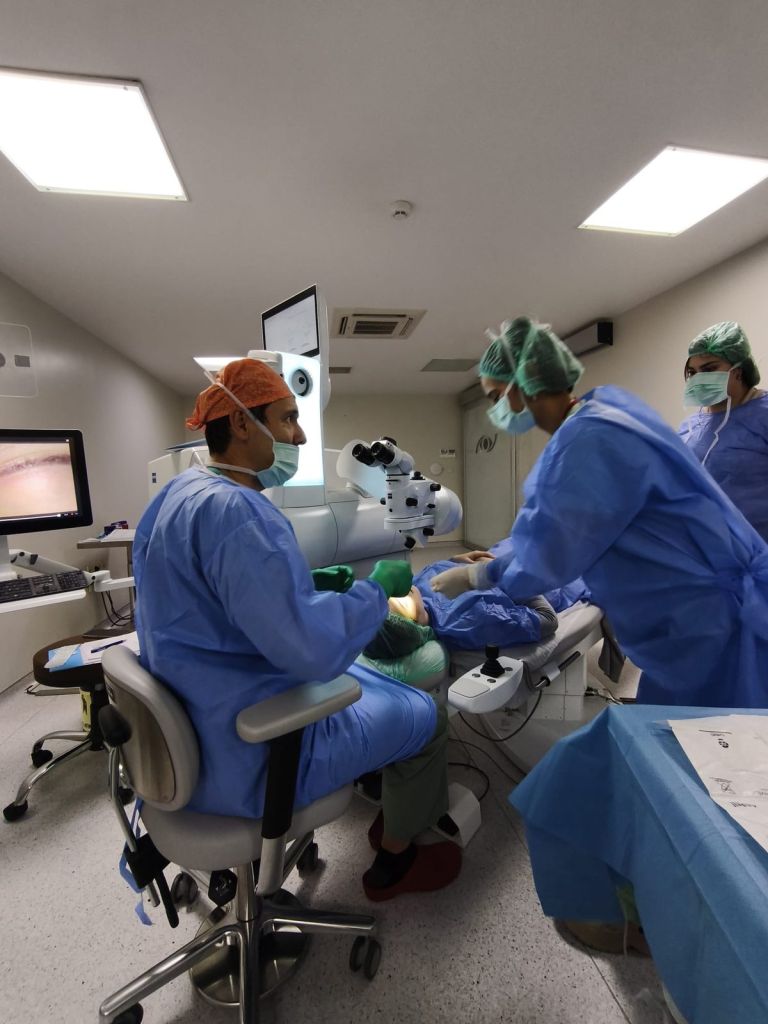
Before the procedure, corneal topography, corneal thickness measurement and tear film evaluation are performed. The aim is to determine whether the cornea is structurally suitable and whether there is sufficient tissue safety for the refractive error to be corrected. During surgery the patient is awake. The ocular surface is anaesthetised with drops and a device that temporarily limits blinking is used. The patient is instructed to look at a fixed light during the laser. This supports centration of the laser within the cornea.
The femtosecond laser shapes the lenticule by separating tissue at a pre-planned plane within the cornea. Then a small access incision is created on the corneal surface. The surgeon gently separates and removes the lenticule through this small opening. No flap is lifted during the procedure; the upper surface of the cornea remains largely intact. Removing the lenticule changes the anterior corneal curvature and achieves the targeted refractive correction. Both eyes may be planned in the same session or in separate sessions. This choice is determined according to the patient’s condition and the surgical team’s assessment.
After the procedure, a protective contact lens may be placed and drop therapy is started. The time spent in the operating room and the laser working time vary according to the individual and the planned correction. The key point is that the method is based on creating a lenticule within the cornea and removing it through a small incision.
Advantages and limitations
The absence of flap creation is associated with less disruption of the nerve network and surface tissue in the upper corneal layers. This feature offers a positive potential for postoperative surface sensitivity and tear film balance; however, not every patient has the same experience. The small incision is considered an approach that relatively preserves the biomechanical integrity of the corneal surface. Because most of the corneal surface remains untouched, flap edge-related problems do not arise in the early postoperative period.
Limitations include the fact that the method is not suitable for every refractive error and every corneal structure. High prescriptions and thin corneas require detailed evaluation for tissue safety. Removing the lenticule through the small incision is a step that depends on the surgeon’s experience; therefore, appropriate patient selection and surgical technique are important. Postoperative visual quality, night vision and tear film status may vary from person to person. Although the new-generation platform improves the workflow and the laser’s action within the tissue, the basic surgical principle remains unchanged. Therefore, expectations should be kept realistic.
Possible complications
As with every laser vision correction procedure, some undesirable conditions may occur with SMILE Pro. In the early postoperative period, temporary dryness, stinging, foreign body sensation and light sensitivity may be reported. Tear film balance usually improves over time. However, this condition may be more pronounced in people with a tendency toward dry eye and may require additional treatment. Temporary fluctuation in vision, halos or glare around lights at night may occur in the early period and most often diminish.
Undercorrection or overcorrection may lead to a need for additional glasses in some patients. Corneal surface irregularity, difficulty during lenticule removal, and rarely infection or inflammation are among the possible complications. If corneal thickness and biomechanical properties are not evaluated appropriately, problems related to corneal thinning may arise; therefore, a detailed preoperative assessment is performed. The risk of complications varies according to individual characteristics, refractive error, and corneal structure. No laser method is without risk. Most potential problems can be managed when detected early; therefore, adherence to the scheduled follow-up appointments is important.
Postoperative course and follow-up
Vision is usually blurred in the first hours after the procedure; it becomes clearer over time. The patient receives drop treatment and recommendations for protecting the ocular surface. Avoiding eye rubbing, using the prescribed drops regularly, and following the given timeframes for swimming or contact lens use are part of the recovery process. A balanced approach to screen time and near work is recommended in the first days; lubricating eye drops may provide relief.
Follow-up examinations are usually scheduled in the early period and in the following weeks. Visual acuity, the corneal surface, tear status, and refractive values are assessed at these visits. If visual fluctuation, significant dryness, or an unexpected symptom occurs, additional evaluation may be needed. The speed of recovery varies from person to person. Some patients return to daily life quickly, while in others tear balance and visual quality settle within a few weeks. The aim of the follow-up process is to monitor healing and adjust treatment when necessary.
Frequently asked questions
What is the main difference between SMILE Pro and classic flap-based laser methods?
In classic flap-based methods, the surgeon creates a liftable cap on the corneal surface and the laser shapes the tissue beneath this cap. In SMILE Pro, no flap is created; the laser prepares a lenticule inside the cornea and the surgeon removes this tissue through a small incision. This difference creates a different profile in terms of the nerve network in the upper layers of the cornea and surface integrity. Although the new-generation platform improves the workflow, the basic principle remains the same.
Can people with dry eye be candidates for this method?
The physician addresses dry eye in detail during the suitability assessment. In people with mild tear film imbalance, the method may be considered with pretreatment and close monitoring. In significant dry eye disease, however, the ocular surface may need to be stabilized first. Although the absence of flap creation is associated with less impact on the corneal nerves, every laser procedure can cause temporary dryness. Therefore, the physician makes the decision after tear tests and ocular surface examination.
When does vision become clear after surgery?
Vision may fluctuate and be blurred in the first days. In many patients, vision improves noticeably within a short time. Full clarity and stabilization of the tear film may take a few weeks, depending on the individual. Halos or glare may occur at night in the early period and usually decrease over time. The speed of recovery varies according to individual factors, the refractive error, and the condition of the ocular surface.
Whether SMILE Pro is suitable is determined individually by evaluating the structural features of the eye, the degree of refractive error, and tear status together. Therefore, a detailed eye examination is the fundamental step in the decision process.
Listen to the Professor
Short videos by Prof. Dr. Ercüment Bozkurt on this topic. Clicking a video opens it on this page.
References
The following resources are compiled from PubMed records.
- Moshirfar M, McCaughey MV, Reinstein DZ et al. Small-incision lenticule extraction. J Cataract Refract Surg 2015;41(3):652-65. DOI · PubMed
- Wan KH, Wang XY, Lai KHW et al. Controversies, consensuses and guidelines on Small Incision Lenticule Extraction (SMILE) by the Academy of Asia-Pacific Professors of Ophthalmology (AAPPO) and the Asia-Pacific Myopia Society (APMS). Asia Pac J Ophthalmol (Phila) 2025;14(4):100221. DOI · PubMed
- Song J, Cao H, Chen X et al. Small Incision Lenticule Extraction (SMILE) Versus Laser Assisted Stromal In Situ Keratomileusis (LASIK) for Astigmatism Corrections: A Systematic Review and Meta-analysis. Am J Ophthalmol 2023;247:181-199. DOI · PubMed
- Krueger RR, Meister CS. A review of small incision lenticule extraction complications. Curr Opin Ophthalmol 2018;29(4):292-298. DOI · PubMed
- Chen KY, Chan HC, Chan CM. How Effective is Keratorefractive Lenticule Extraction Surgery (KLEx) in Reducing Dry Eye Outcomes Compared to LASIK?: A Systematic Review and Meta-analysis. J Refract Surg 2025;41(8):e839-e854. DOI · PubMed
What determines the price of SMILE pro?
The price of SMILE pro varies from person to person and case to case. The main factors are:
- Method and technology used
- Type and degree of refractive error and corneal measurements
- Required tests and imaging
- Hospital and operating room where the procedure is performed
- Scope of follow-up and control examinations
Price information is not shared on this page. Personalized information is provided by the appointment office after examination and measurements. You can also contact this office about coverage by health insurance.
Frequently asked questions
What is the difference between SMILE Pro and flap-based methods?
SMILE Pro does not create a liftable cap as in flap-based methods. The lenticule is removed through a smaller access opening on the corneal surface; there are no flap edge, flap lifting, or flap repositioning steps.
What does flapless laser mean, and who is SMILE Pro suitable for?
Flapless laser means a laser method performed without creating a flap (corneal cap) on the corneal surface. In SMILE Pro, the laser prepares a piece of tissue (lenticule) inside the cornea, and this tissue is removed through a small incision. The method is applied to patients with myopia and myopic astigmatism. It is not applied to patients with hyperopia or high astigmatism; other laser methods are considered for these patients. Suitability is determined at the examination with measurements such as corneal thickness, topography and tear balance.
What is done during the procedure?
The ocular surface is anaesthetised with drops, and a device that temporarily limits blinking is used. The patient is instructed to look at a fixation light during the laser procedure. The femtosecond laser shapes the lenticule within the cornea, and the surgeon separates and removes the lenticule through a small incision.
Who is not a suitable candidate?
A markedly thinned cornea, an irregular corneal surface, active ocular infection or inflammation, uncontrolled severe ocular surface disease, and temporary conditions such as pregnancy or breastfeeding may be limiting factors. Progressive corneal thinning, significant dry eye disease, and certain systemic diseases also affect candidacy. The physician makes the final decision after examination and corneal imaging.
Which temporary symptoms may occur after surgery?
In the early period, temporary dryness, stinging, foreign body sensation, and light sensitivity may be reported; the tear film balance usually improves over time. Temporary fluctuation in vision and halos or glare around lights at night may occur and most often decrease. In people with a tendency to dry eye, this condition may be more pronounced and may require additional treatment.
What does the price of SMILE pro depend on?
The price of SMILE pro varies from person to person and case to case. The main factors are: Method and technology used; Type and degree of refractive error and corneal measurements; Required tests and imaging; Hospital and operating room where the procedure is performed; Scope of follow-up and control examinations. Price information is not shared on this page. Personalized information is provided by the appointment office after examination and measurements. You can also contact this office about coverage by health insurance.
Where can I read patient reviews about SMILE pro?
You can read patient reviews in the patient reviews section at the bottom of this page.
The information on this page is provided for general informational purposes only; diagnosis and treatment decisions are based on examination findings. This content does not replace medical advice.
For appointments and information
You can send your pre-examination questions via WhatsApp or contact us by phone.